Showing posts with label considering Seepage. Show all posts

Thursday, March 30, 2017

Unauthorized annotated Fyfe coauthors letter to US Rep. Lamar Smith

The Fyfe et al 2016 clarifying letter to US Representative Lamar Smith is well written.  There's nothing to complain about and I don't.  Still at 1000 word there's only so much it can say, and I'm going to use this opportunity to make my point using the words of other scientists.  Remember my beef is about communication, not the science.

I’ve borrowed from about a dozen climate studies, along with some other info and let their quotes speak for themselves.  I apologize for some of the hard feeling.  I do not apologize pushing for better recognition of our* failures to communicate, how else can we learn, how else can we improve?  (slight edit, I realized Josh Willis' quote belongs at the start of this reading, not at the end.)

Best Wishes.  

For the background to this, link here
* Climate science communicators big and little.

“One way to think about it is that global warming continued, but the oceans just juggled a bit of heat around and made the surface seem cooler for a while” 
Joshua Willis Ph.D. - JPL

Source for the text:

Letter to Lamar Smith
March 28, 2017    communication   Ed Hawkins  Climate Lab Book

The Committee on Science, Space & Technology of the US House of Representatives conducts regular evidence hearings on various science topics. On Wednesday 29th March, there is a hearing on “Climate science: assumptions, policy implications, and the scientific method”. The following letter, summarising the scientific findings of Fyfe et al. (2016) and Karl et al. (2015), has been submitted as evidence to this hearing.

The broader context is that the Committee Chairman, Mr. Lamar Smith, has previously discussed the findings of Fyfe et al. (of which I was a co-author), claiming: “A new peer-reviewed study, published in the journal Nature, confirms the halt in global warming”

This statement is incorrect, and motivated the clarification on what Fyfe et al. actually says.

Dear Mr. Smith,
We are coauthors of the Fyfe et al. paper published in 2016 in Nature Climate Change [1]. You recently referenced this paper at a Subcommittee hearing on March 16, 2016 [2]. We are writing to clarify what the Fyfe et al. paper actually finds and claims. We also want to ensure that the conclusions of the Fyfe et al. paper are not misconstrued as a criticism of Thomas Karl, of the Karl et al. paper published in Science in 2015 [3], or of the valuable research that Dr. Karl and his team have performed over many years.


Thursday, February 25, 2016

Obsessing over global temperatures, example of fraud driven "seepage"


The number one dodge and time waster in our global warming public awareness dialogue is the nonstop obsessing over temperatures, taking them, processing them, matching models.  Every new study is treated as though this were some kind of ball game with armchair quarterbacks right and left.  

Thing is, those temperature numbers are useless information if you don't first grasp the fact of greenhouse gases and how they control our planet's insulation against frigid space.  We know this added heat is being absorbed into our global climate system, there's no where else for it to go undetected.

The physics means that everything under that atmosphere will absorb some of that added warmth.  Period!
Measuring those varied temperatures moving through the global system 100% is impossible, but why would that change the physics of what's going on?

Besides, we do have overwhelming thermometer-independent evidence.

27 -- The evidence for climate change WITHOUT computer models or the IPCC

potholer54  |  Published on May 9, 2013  |  16:02 min

What's hideous is all the people who glibly dismiss the geophysics of greenhouse gases which is clearly known to a high degree of certitude.  And instead pretend that human's ability to measure the actual heat moving through our global heat and moisture distribution engine is the be all and end all of what they need to know.  

With that bit of venting, allow me to introduce you to an excellent primer on how well scientists understand the physics of our atmosphere.  By way of a map to Dr. David Archer's excellent college level course, which is freely available at YouTube.   This I follow with information about "seepage" from the man who coined the term, Dr. Lewandowsky. Finishing with a couple links to Admiral David Titley, and climatologist Gavin Schmidt who explain a bit more about temperatures and climate models.

Dr. David Archer
Global Warming
Understanding the Forecast

Global Warming: Understanding the Forecast is a comprehensive introduction to all aspects of global warming. Written in an accessible way, and assuming no specialist prior knowledge, this book examines the processes that control climate change and climate stability, from the distant past to the distant future.

Friday, September 18, 2015

Seepage, impacts of a chimera - Lewandowsky, Risbey, Oreskes study

Stephan Lewandowsky together with James Risbey and Naomi Oreskes published a new study looking at how the contrarian PR campaign has influenced the way serious climate science was being done.  Here's the abstract followed by some more information regarding the pause and a previous "Seepage" study.

Bulletin of the American Meteorological Society 2015 

The “Pause” in Global Warming: Turning a Routine Fluctuation into a Problem for Science

Stephan Lewandowsky
University of Bristol and University of Western Australia
James S. Risbey
CSIRO Oceans and Atmosphere, Hobart, Tasmania
Naomi Oreskes
Harvard University

Capsule 
Contrarian discourse about a “pause” in global warming has found traction in climate science even though there is little evidence for anything but a fluctuation in the warming rate similar to earlier deviations from a longer-term trend.

Sunday, June 21, 2015

considering our climate system

(June 21, 2015)

Goal of this article: A) To convey a recognition and appreciation of the fundamental components of our planet's climate system.  B)  To explain the difference between "Global Surface Temperature" and the "Global Temperature" (Something everyone conflates way the heck too often!).

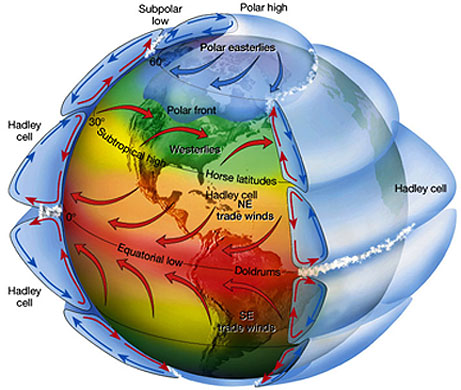
Our Earth's climate is a global heat and moisture distribution engine consisting of three major components.

There's the atmosphere with it's distinctive layers, the lowest one is called the troposphere, it's where our weather lives.  The troposphere varies in height from around five miles at the poles up to around twelve miles at the equator.  


The troposphere is held in place and insulated from space by the stratosphere, mesosphere, thermosphere and finally the exosphere topping out in the neighborhood of three hundred miles - actually, on the leeward side of Earth it goes way beyond, but that's a different story.

Fortunately for life, our atmosphere contains certain greenhouse gases that act to slow down the heat escaping from the surface thus acting as insulation that keeps our planet livable.  The troposphere holds pretty much all the water in the atmosphere, scientists calculate it adds up to a little over 3,000 cubic miles of liquid water.  If spread over the Earth's surface it would amount to an inch