I've been working on an open letter to Dr. Judith Curry and since there's no room there for getting into all the reasons I feel justified in writing such a letter to this scientist who traded in her standing among scientists as a respected colleague, for her current standing as an adored celebrity for the Global Warming Denial PR Community, I've compiled this collection of articles that look into various aspects of Judith Curry's brand of science in a vacuum, and science by rhetoric.
Showing posts with label Peter Sinclair. Show all posts
Showing posts with label Peter Sinclair. Show all posts
Thursday, May 8, 2014

Saturday, December 14, 2013
The Oregon Institute of Science and Medicine Petition on climate change
I've been carrying on a conversation over at a weird little YouTube video named "Denier land: How deniers view global warming." The thing is a textbook example of what's called an "Argument from Incredulity." Meaning that the person is flailing at information that he obviously doesn't understand, like a petulant school boy angry at a teacher who's just flunked him.
Rather than trying to learn something from that information he hides behind ridicule while ignoring all he doesn't understand. I know many people behave like that, but it's definitely no way to learn anything.
In any event, I've been commenting over there and some folks keep challenging me with different, not new, twists on the climate science skeptics handbook of excuses for ignoring what a world wide community of tens of thousands of professionals and experts agree on.
For example, take the following claim:
""More than 2,000 scientists from 154 countries typically participate in the IPCC process"
That is not only dishonest but unimpressive too. Over 30,000 scientists in the USA alone signed a petition disagreeing. Prominent scientists around the world with far more credibility than the anonymous 2000 so-called scientists agree with those 30,000.
You could dispute these figures, as many are not in relevant fields and many do not have higher degree or research backgrounds. However if you did so you admit to your dishonesty, as most of the 2000+ you claim are not researchers, most are not experts in their fields and many do not have PhDs, unlike over 9000 of those in those 30,000."
That, along with other pitches for the "OISM Petition," has inspired me to compose this compilation of information regarding the Oregon Petition, finishing with a REPOST of a DeSmogBlog story examining Arthur Robinson and his one-man operation, the so-called "Oregon Institute of Science and Medicine"
Tuesday, August 13, 2013
INDEX for my Climate Science Video Collection
My first website http://citizenschallenge.blogspot.com developed into a venue that focuses primarily on Earth observations, climate science and education, whereas I started this website to focus on climate science deniers and to examine some of their ruthless attacks on rational thinking and learning.
Since attempting to encourage serious learning by sharing authoritative sources of information is also at the heart of this website. I've decided to share some links to a series of posts where I've collected some first class climate science education videos and lectures.
Enjoy and happy learning!
Friday, April 19, 2013
More examinations of the DailyMail's, David Rose's disingenuous stories
A collection of articles examining the claims by "news reporter" David Rose.
We'll start this collection with a post by the official Met Office blog, followed by a few more interesting articles examining the logic of David Rose
~ ~ ~ ~ ~ ~ ~ ~ ~ ~ ~ ~ ~
Met Office in the Media: 29 January 2012
http://metofficenews.wordpress.com/2012/01/29/met-office-in-the-media-29-january-2012/
Today the Mail on Sunday published a story written by David Rose entitled “Forget global warming – it’s Cycle 25 we need to worry about”.
This article includes numerous errors in the reporting of published peer reviewed science undertaken by the Met Office Hadley Centre and for Mr. Rose to suggest that the latest global temperatures available show no warming in the last 15 years is entirely misleading.
Despite the Met Office having spoken to David Rose ahead of the publication of the story, he has chosen to not fully include the answers we gave him to questions around decadal projections produced by the Met Office or his belief that we have seen no warming since 1997.
For clarity I have included our full response to David Rose below:A spokesman for the Met Office said: “The ten year projection remains groundbreaking science. The complete period for the original projection is not over yet and these projections are regularly updated to take account of the most recent data.
“The projections are probabilistic in nature, and no individual forecast should be taken in isolation. Instead, several decades of data will be needed to assess the robustness of the projections.
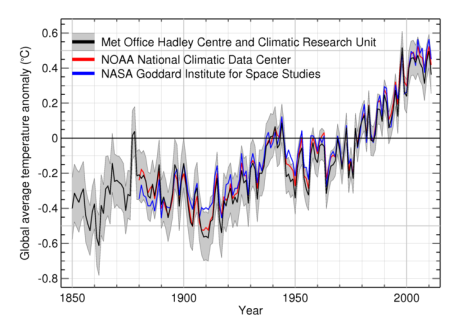
“However, what is absolutely clear is that we have continued to see a trend of warming, with the decade of 2000-2009 being clearly the warmest in the instrumental record going back to 1850. Depending on which temperature records you use, 2010 was the warmest year on record for NOAA NCDC and NASA GISS, and the second warmest on record in HadCRUT3.”
Furthermore despite criticism of a paper published by the Met Office he chose not to ask us to respond to his misconceptions. The study in question, supported by many others, provides an insight into the sensitivity of our climate to changes in the output of the sun.

It confirmed that although solar output is likely to reduce over the next 90 years this will not substantially delay expected increases in global temperatures caused by greenhouse gases. The study found that the expected decrease in solar activity would only most likely cause a reduction in global temperatures of 0.08 °C. This compares to an expected warming of about 2.5 °C over the same period due to greenhouse gases (according to the IPCC’s B2 scenario for greenhouse gas emissions that does not involve efforts to mitigate emissions). In addition the study also showed that if solar output reduced below that seen in the Maunder Minimum – a period between 1645 and 1715 when solar activity was at its lowest observed level – the global temperature reduction would be 0.13C.
~ ~ ~ ~ ~ ~ ~ ~ ~ ~ ~ ~ ~
This week’s top six rebuttals to David Rose’s “warming has stopped” claim
Thursday, November 15, 2012
The Educational Climate Science videos of Peter Hadfield
I just posted this over at my Citizenschallenge blogspot, but considering the denial of information that skeptics are guilty of I've decided to also post it over here. It's for folks who are interested in learning more. It is true that Hadfield get's attacked by some skeptics, er denialist - but the proof is in the pudding and if you follow up on the authoritative sources upon which Hadfield reports, you will find that he is true to the data and has much to share.
While "skeptical" websites such as Curry's blog, or WUWT, or ClimateAudit, et al. spend endless hours side tracking the real issues and making mountains out of moles, in order to shield themselves for the full spectrum of Earth observation evidence ~ Hadfield's series explains the various aspects of our global heat distribution engine and why we as a people should be taking the scientists' consensus seriously.
And since I have some free time, I figured why not put together an index of Peter Hadfield's video series ~ it does an excellent job of reviewing what the scientific "consensus" on Climate Change is all about.
Grab the popcorn and sit down for some easy learning. ;-)
Potholer Climate videos
Peter Hadfield
~~~~~~~~~~~~~~~~~~~~~~~~~~~~~~~~~~~~~~~~~
This has been all about Peter Hadfield but I shouldn't ignore Peter Sinclair, aka Greenman3610, and his top notch coverage of the AGW "debate"... story...
Greenman3610 ~ Climate Denial Crock of the Week
~ ~ ~ ~ ~ ~ ~
Peter Sinclair interviews Peter Hadfield
Potholer54/Greenman3610 - The Search for Lord Monckton
~~~~~~~~~~~~~~~~~~~~~~~~~~~~~~~~~~~~~~~~~
A little deep background is also valuable.
Here is an interesting series that introduces one to Earth as a dynamic entity. Incidentally, I believe it's impossible to appreciation AGW without appreciating the evolution of climate.
How the Earth Made Us
Professor Iain Stewart
BBC documentary
Wednesday, November 7, 2012
Hurricane Sandy in context - a collection of articles and links
I think it's time for some real Earth Observations and science. The contrarians over at Judith's website talk endlessly, making claims, but always leading away from looking at Earth observations. While exuding an attitude that, not knowing everything is the same as knowing nothing. They seem to have no appreciation of our planet's climate as a huge Global Heat Distribution Engine. Instead trusting that a sharp intellect can outsmart Earth processes.
Unfortunately, argue all you want about minute details, or the exactitude of measurements, or philosophizing about science... the bottom line is that we have been doping our atmosphere, and it is impacting our planet in one direction. Our climate is transitioning to a new state - and the less we do to turn down the ongoing doping of our atmosphere the worse the disruptions to the world and life style {we've come to depend on} are going to get.
Since all eyes have been on Hurricane, turned superstorm, Sandy. She's worth a review since she is symptomatic of the changes society's Grand Atmospheric Experiment is bringing to weather processes. Below is a large selection of good articles that lead to authoritative sources that explain the dynamics at work:

Superstorm Sandy
~~~~~~~~~~~~~~~~~~~~~~~~~~~~~~~~~~~~~~~~~~~~~~~~~~~~~~~~~~~~~~~~~~~~~~~~~~~~
How Does Climate Change Make Superstorms Like Sandy More Destructive?
~ ~ ~ ~ ~ ~ ~
Trenberth: Hurricane Sandy Mixes Super-Storm Conditions With Climate Change

~ ~ ~ ~ ~ ~ ~
The Scientist
Opinion: Super Storm Sandy
What role did climate change play in this week’s massive hurricane?
| October 31, 2012
http://www.the-scientist.com/?articles.view/articleNo/33084/title/Opinion--Super-Storm-Sandy/
~ ~ ~ ~ ~ ~ ~
Why did Hurricane Sandy take such an unusual track into New Jersey?
~ ~ ~ ~ ~ ~ ~
Frankenstorm: Has Climate Change Created A Monster?
by ADAM FRANK ~ October 28, 2012
~ ~ ~ ~ ~ ~ ~
Rose and Curry Double Down on Global Warming Denial
Posted on 23 October 2012 by dana1981
Hurricane Sandy had nothing to do with global warming
http://www.skepticalscience.com/hurricane-sandy-global-warming.htm
~ ~ ~ ~ ~ ~ ~ ~ ~ ~ ~ ~ ~ ~ ~ ~ ~ ~ ~ ~ ~ ~ ~ ~ ~ ~ ~ ~ ~ ~ ~ ~ ~ ~ ~
Climate Crock of the Week with Peter Sinclair
New Video:
Hurricane Sandy’s Double Whammy
November 5, 2012
~ ~ ~ ~ ~ ~ ~ ~ ~ ~ ~ ~ ~ ~ ~ ~ ~ ~ ~ ~ ~ ~ ~ ~ ~ ~ ~ ~ ~ ~ ~ ~ ~ ~ ~
2012 SkS News Bulletin #1: Hurricane Sandy & Climate Change
http://www.skepticalscience.com/2012-SkS-News-Bulletin-1_Hurricane-Sandy.html
Posted on 31 October 2012 by John Hartz
This is a round-up of selected news articles and blog posts about Hurricane Sandy, its impacts on North America, and its relationship to climate change. This bulletin supplements the regular SkS weekly News Round-Up which is posted on Saturday of each week.
Sunday, Oct 28
- Hurricane Sandy: Climate Change Activists Offer Stark Reminder Before Storm Hits by Lucas Kavner, The Huffington Post, Oct 28, 2012
- The #Frankenstorm in Climate Context by Andrew Revkin, Dot
Earth, New York Times, Oct 28, 2012 - Shallow Waters and Unusual Path May Worsen the Surge by Kenneth Chang $ Henry Fountain, New York Times, Oct 28, 2012
- Frankenstorm: Has Climate Change Created A Monster? by Adam Frank, NPR, Oct 28, 2012
Monday, Oct 29
- Hurricane Sandy mixes super-storm conditions with climate change by Kevin Trenberth, The Conversation, Oct 29, 2012
- In Hurricane Sandy's Fury, The Fingerprint Of Climate Change by Tom Zeller Jr., The Huffington Post, Oct 29, 2012
- Sandy versus Katrina, and Irene: Monster Hurricanes by the Numbers by Mark Fischetti, Scientific American, Oct 29, 2012
- Extremely Dangerous Hurricane Aims at New York City and Mid-East Coast Areas by Lauren Morello , Colin Sullivan and ClimateWire, Scientific American, Oct 29, 2012
- Hurricane Sandy Puts More Than $87 Billion Worth Of Homes At Risk by Morgan Brennan, Forbes, Oct 29, 2012
- Aliens, Sandy And The Coming Global Superstorms by Kenneth Rapoza, Forbes, Oct 29, 2012
- Weather or Climate: What Caused Hurricane Sandy? by Stephanie Pappas, LiveScience, Oct 29, 2012
- 'Storm Like No Other': Ongoing Coverage as Powerful Hurricane Sandy Makes Landfall by Common Dreams staff, Common Dreams, Oct 29, 2012
- For New York, the Issue of Steps Not Taken by Mireya Navarro, New Yorkl Times, Oct 29, 2012
- What lessons from hurricane Sandy? by the Editorial Board, The Christian Science Monitor, Oct 29, 2012
- We Are All from New Orleans Now: Climate Change, Hurricanes and the Fate of America's Coastal Cities by Mike Tidwell, The Nation, Oct 29, 2012
- On ‘Frankenstorms,’ Climate Science and ‘Reverse Tribalism’ by Andrew Revkin, Dot Earth, New York Times, Oct 29, 2012
- Yes, Hurricane Sandy is a good reason to worry about climate change by Brad Plumer, Ezra Klein's WonkBlog, Washington Post, Oct 29, 2012
- Hurricane Sandy's Economic Impact Likely To Be Immense by Marilyn Geewax, NPR, Oct 29, 2012
- On Not Scaring Ourselves to Death: Moving Beyond the Adrenaline Rush of a Good Storm to an Energy Revolution by Daphne Wysham, Institute for Policy Studies, Oct 29, 2012
- Slow-moving hurricanes such as Sandy on the rise by Michael Marshall, New Scientist, Oct 29, 2012
- Did Climate Change Supersize Hurricane Sandy? By Chris Mooney, Mother Jones, Oct 29, 2012
Tuesday, Oct 30
- Amid Hurricane Sandy, climate change talk is in order by the Editorial Board, Newark News-Ledger, Oct 30, 2012
- How Superstorm Sandy Became a Snowstorm by Stephanie Pappas, LiveScience, Oct 30, 2012
- Sandy Deals New York City Flooding, Fire And Blackouts by Scott Neumann, NPR, Oct 30, 2012
- Sandy leaves NYC subway system, infrastructure licking its wounds by James Eng, NBC News, Oct 30, 2012
- Obama declares major disaster in NYC, NJ as Sandy kills 28, causes major flooding and fires by Miguel Llanos, NBC News, Oct 30, 2012
- Television News Outlets Ignore Climate Change During Sandy Coverage. Should We Really Be Surprised? by Stephen Lacey, Climate Progress, Oct 30, 2012
- Global Warming Systemically Caused Hurricane Sandy by George Lakoff, The Huffington Post, Oct 30, 2012
- Climate Change Takes The Campaign By Storm: Countdown Day 7 by Howard Fineman, The Huffington Post, Oct 30, 2012
- Hurricane Sandy spins up climate discussion by Jeff Tollefson, Nature, Oct 30, 2012
- Hurricane Sandy Pushing Obama, Romney to Break Climate Silence by Common Dreams staff, Common Dreams, Oct 30, 2012
- Can climate change gatecrash the race for the White House? by Tom Mitchell, Shaping Policy for Development, Oct 30, 2012
- Change and Sandy: Why We Need to Prepare for a Warmer World by Bryan Walsh, Ecocentric, Time, Oct 30, 2012
~ ~ ~ ~ ~ ~ ~ ~ ~ ~ ~ ~ ~ ~ ~ ~ ~ ~ ~ ~ ~ ~ ~ ~ ~ ~ ~ ~ ~ ~ ~ ~ ~ ~ ~
2012 SkS News Bulletin #2: Hurricane Sandy & Climate Change
http://www.skepticalscience.com/2012-SkS-News-Bulletin-2_Hurricane-Sandy.html
Posted on 4 November 2012 by John Hartz
This is the second installment of a a round-up of selected news articles and blog posts about Hurricane Sandy, its impacts on the Caribbean and North America, and its relationship to climate change. This bulletin supplements the regular SkS weekly News Round-Up which is posted on Saturday of each week. A key pragraph has been extracted verbatim from each article in order to provide insight into the article's content.
Arriving atop fantastically warm water and aided by a full foot of sea-level rise during the last century, Hurricane Sandy is just the latest example of climate change’s impact on human society. Unless we rapidly phase out our use of fossil fuels, most Americans within shouting distance of an ocean will—in coming years—live behind the sort of massive levees and floodgates that mark Louisiana today.
We Are All from New Orleans Now: Climate Change, Hurricanes and the Fate of America's Coastal Cities by Mike Tidwell, The Nation, Oct 29, 2012
As the Caribbean reaches the end of October – the second-to-last month of the Atlantic hurricane season – Sandy has caused significant material losses and claimed the lives of 44 people in Haiti, 11 in Cuba, two in the Dominican Republic, one in Jamaica and one in the Bahamas.
Caribbean Faces Increasing Fury of Storms by Patricia Grogg, Inter Press Service (IPS), Oct 29, 2912
Hurricane Sandy seems straight out of a Hollywood apocalyptic blockbuster. But a confluence of environmental and topographical characteristics helps explain its vast size, slow progress, storm surge and multiple methods of wreaking havoc on the coast and deep inland, scientists say.
The science behind Hurricane Sandy: a confluence of trouble by Neela Banerjee, Los Angeles Times, Oct 29, 2012
But no president can cross Big Oil in the way that is required to defuse the climate crisis without the help of a powerful and sustained popular movement. If Hurricane Sandy contributes to building such a movement—and McKibben and his fellow activists at 350.org and allied organizations are launching a national tour shortly after Election Day that aims to do just that—America might still avoid the curse of Cassandra by heeding her warnings at last.
Hurricane Sandy as Greek Tragedy by Mark Hertsgaard, The Nation, Oct 30, 2012
Watching the images of Sandy leaving a path of destruction brings back memories of the day after Hurricane Andrew hit my home in Miami back in 1992. The state of shock as my parents and I approached our storm ravaged home is still fresh in my memory even 20 years later as I see the faces of those who are experiencing the same today.
Superstorm Sandy Reminds Us Why We Have to Care About Climate Change by Adrianna Quintero, The Huffington Post, Oct 31, 2012
By the time Hurricane Sandy hit the Northeast coast on Monday, upending lives across the Eastern half of the country, it had become a freakish hybrid of a large, late-season hurricane and a winter storm more typical of the middle latitudes. Though by no means unprecedented, that type of hybrid storm is rare enough that scientists have not studied whether it is likely to become more common in a warming climate.
Are Humans to Blame? Science Is Out by Justin Gillis, New York Times, Oct 31, 2012
But scientists agree on one point: Rising sea levels caused primarily by global warming could worsen the effects of storms such as Sandy, particularly when it comes to storm surge. And that means coastal communities throughout the United States must think about what they’ll need for protection from such storms.
Did climate change play a role in Sandy’s strength? by Erika Bolstad, McClatchy Newspapers, Oct 31, 2012
The images of a paralysed New York City at the mercy of Hurricane Sandy's wall of water have forced climate change on to the political agenda in the final week of the 2012 presidential election campaign. Even before Sandy made landfall political commentators were debating whether the storm would be better for Mitt Romney or Barack Obama. In any event it has brought forth statements from prominent Democrats and elected officials on climate change and spurred public debate about the neglected topic.
Sandy puts climate change back on the US election agenda by Suzanne Goldberg, The Gaurdian, Oct 31, 2012
Miller strongly disagreed with my discussion of the science revealing past patterns of extreme storminess in the Northeast and the science pointing to a rising human influence on some (but not all) kinds of extreme weather. The exchange is worth posting here now (Miller gave permission), to give you a sense of how intelligent people with related, if not identical, goals can interpret a large body of science very differently:
Two Views of a Superstorm in Climate Context by Andrew Revkin, Dot Earth, New York Times, Oct 31, 2012
"Folks, second year in a row the New York metro area has been [hit] by this stuff," said Todd, NBC News's Chief White House Correspondent and host of The Daily Rundown on MSNBC. "Let's not bury our heads in the sand when it comes to something has changed in the Atlantic. The climate has changed. It's called climate change, folks."
Sandy Forces Media And Politicians To Talk About Climate Change by Ruby Kramer, BuzzFeed, Oct 31, 2012
Up to now, New York's response to flood threats has been to build smaller-scale barriers around facilities to make them more resilient to flooding. A multibillion-dollar project to create a storm surge defense system hasn't been on the agenda. "The city has been very polite, and they agree that in the long term it will become a necessity," Bowman said. "But for now they say, not yet. They're focusing on resilience, solutions to small problems."
NYC flood was foreseen: Now what? by Alan Boyle, Cosmic Log, NBCNews.com, Oct 31, 2012
Democrats have been AWOL on climate change, but Republicans have been even more recalcitrant. Their failure is odd, because in other areas of national security Republicans pride themselves on their vigilance. Romney doesn’t want to wait until he sees an Iranian nuclear weapon before acting, so why the passivity about climate change?
Will Climate Get Some Respect Now? by Nicholas D. Kristof, New York Times, Oct 31, 2012
A huge storm barrels down on the United States, wreaking havoc with punishing winds, record flooding, heavy snowfall and massive blackouts. Is the main culprit climate change or a freak set of coincidences?
Climate change, or crap shoot? Experts weigh Sandy's causes by Julie Steenhuysen and Alister Doyle, Alertnet/Reuters, Oct 31, 2012
Climate science explains how global warming can make a superstorms like Sandy more destructive in several ways:
How Does Climate Change Make Superstorms Like Sandy More Destructive? by Joe Romm, Climate Progress, Oct 31, 2012
The evidence is not yet in for the East Coast in 2011 and 2012, but the general trends are increasingly clear. In its 2012 report on managing the risks of extreme events and disasters, the Intergovernmental Panel on Climate Change (IPCC) concluded that "A changing climate leads to changes in the frequency, intensity, spatial extent, duration, and timing of extreme weather and climate events, and can result in unprecedented extreme weather and climate events."
Climate change is real by Chris Field, Special to CNN, Nov 1, 2012
Earlier this week, New York's Gov. Andrew Cuomo (D) issued a pointed statement on climate change and its role in the monstrous storm from which his state -- and many others -- will be recovering for months, and perhaps years, to come.
"It's a longer conversation, but I think part of learning from this is the recognition that climate change is a reality," Cuomo said. "Extreme weather is a reality. It is a reality that we are vulnerable."
Hurricane Sandy's Link To Climate Change: Does It Matter? by Tom Zeller Jr., The Huffington Post, Nov 1, 2012
I’ve tried this week, as sporadic Internet access allowed, to foster some productive discourse amid a media environment that seems dead-set on creating polarization. The two most vivid examples on my mind at the moment are “It’s Global Warming, Stupid,” a much-shared essay in Bloomberg Businessweek, and an effort by Anthony Watts, inspired by a ridiculous U.S. News Sandy-warming poll, to list scientists and commentators for and against global warming as the storm’s cause.
On Hurricanes, Presidents, Climate and One Clear Human Factor in the Sandy Disaster by Andrew Revkin, Dot Earth, New York Times, Nov 1, 2012
In a surprise announcement, Mayor Michael R. Bloomberg said Thursday that Hurricane Sandy had reshaped his thinking about the presidential campaign and that as a result he was endorsing President Obama.
Bloomberg Endorses Obama, Citing Climate Change by Raymond Hernandez, New York Times, Nov 1, 2012
As NCAR’s Gerald Meehl, a co-author of the study, explained to me by e-mail, it’s a lot easier to stabilize global temperatures by cutting carbon emissions than it is to stabilize sea-level rise. The carbon-dioxide that we’ve already loaded into the atmosphere will likely have effects on the oceans for centuries to come. “But with aggressive mitigation,” Meehl added, “you can slow down the rate of sea level rise, which buys time for adaptation measures.”
Can we stop the seas from rising? Yes, but less than you think. by Brad Plumer, Ezra Klein's Wonk Blog, Washington Post, Nov 1, 2012
Bloomberg Businessweek editor Josh Tyrangiel tweeted, "Our cover story this week may generate controversy, but only among the stupid."
Businessweek Hurricane Sandy Cover: 'It's Global Warming, Stupid' (PHOTO), Media, the Huffington Post
Hurricane Sandy has broken the so-called “climate silence” of this year’s elections. The storm has thrown a wrench into campaign efforts, halting activities Monday and Tuesday as it became impossible to ignore the topic of climate change, which has penetrated the national dialogue.
Hurricane Sandy Fans Flames of Climate Change Debate by Rebecca Hanser, Inter Press Service (IPS), Nov 1, 2012
“While one storm ‘might have happened anyway’ in a mythical non-industrial world, the general level of weird weather (an amalgam of many events) is clearly caused by anthropogenic greenhouse gases,” says David Archer, a professor at the University of Chicago, in an email. “Like you could figure out that dice are loaded by tossing them a few times, more than just once.” (His book, The Long Thaw, is one of the best quick reads on climate change.)
What If Mike Bloomberg Is Right And A Climate Change Nightmare Is Here? by Matthew Herper, forbes, Nov 2, 2012
On Tuesday, I posted some suggestions for how people could help the victims of Hurricane Sandy here in the United States. I neglected to mention the horrific suffering in impoverished Haiti, which was pummeled by Sandy’s devastating trajectory before she hit US shores.
Don't Forget Haiti by Peter Rothberg, The Nation, Nov 2, 2012
Those crazy, radical hippies at Bloomberg Businessweek have gone and done it. With the blunt, no-nonsense cover that likely already appeared on your Facebook feed or Twitter stream or Tumblr dashboard, Businessweek dared state with certainty what so many media outlets have nervously danced around in their coverage of Superstorm Sandy: It’s Global Warming, Stupid.
Bloomberg Businessweek Gets It Right: Sandy Wasn't "Caused" By Climate Change - It IS Global Warming by Ben Jervey, DeSmog Blog, Nov 2, 2012
~ ~ ~ ~ ~ ~ ~
~ ~ ~ ~ ~ ~ ~
Subscribe to:
Posts (Atom)