The Contender writes: "@citizen, My argument is that scientists fall victim to group think sometimes."
~ ~ ~ ~ ~ ~ ~
How about admitting that all people fall victim to "group think" sometimes, some groups more than others?
With politicians and political advocates being near the top of the list of people who are susceptible to group think. In fact, they enthusiastically embrace group think, just look at the Republican or the Tea Party's xenophobia towards new or different ideas. Heck listen to the Republican's ranking member of the Science Committee, Rep. Paul Broun: If it ain't in the Bible it's "Hell-spawned lies." And, interestingly these are exactly the folks who scream loudest that their claims should be trusted more than the professional experts who understand the science.
But the thing is that "science" by it's very nature is skeptical, self-examining and open to self-correction since acquiring solid facts and genuine learning is its goal. Competing and cross checking each other's work and looking for the break-through to new perspectives and understanding is its imperative. And finding oneself making mistakes is an accepted part of the learning process - as opposed to the political arena where admitting a mistake is next to suicide.
The Contender then goes on:
"You are simply wrong about the facts you are claiming about the Hockey Stick. The observation remains that if all the proxies are just put into the standard processing methods, the traditional reconstruction of climate emerges including the Medieval Warm Period and the Little Ice Age. Only by massaging the data can the past climate events be made to vanish.'
~ ~ ~
The problem here is that only by limiting yourself to the science presented by the usual suspects, such as Heartland, SPPI, ClimateAudit, WUWT and such members of the echo-chamber can such a claim be sustained. The problem with those sources is they do science in a vacuum - meaning science that's isolated from the sunshine of open review and critique by experts in the field.
This is why I decided to break into the RealClimate.org files in order to reproduce a record of their discussion regarding the Hockey Stick. Mind you "Mr. Hockey Stick", that is Dr. Mann, is one of the authors at RC. I bring this up because in America when we charge someone with misdeeds or crimes - we allow, and in fact, expect them to respond to incriminating claims made against them.
Thus, in the spirit of breaking through the bubble of protection the Republican echo-chamber has circled their fears and denial within I present the following expose' of the record of evidence:
========================
The Contributors to RealClimate
Filed under: Contributor Bio's — group @ 6 December 2004
~ ~ ~ 2004 ~ ~ ~
Dec 4, 2004 ... Instrumental data describing large-scale surface temperature changes are only available for roughly the past 150 years. Estimates of surface temperature changes further back in time must therefore make use of the few long available instrumental records or historical documents and natural archives or ‘climate proxy’ indicators, such as tree rings, corals, ice cores and lake sediments, and historical documents to reconstruct patterns of past surface temperature change. Due to the paucity of data in the Southern Hemisphere, recent studies have emphasized the reconstruction of Northern Hemisphere (NH) mean, rather than global mean temperatures over roughly the past 1000 years.
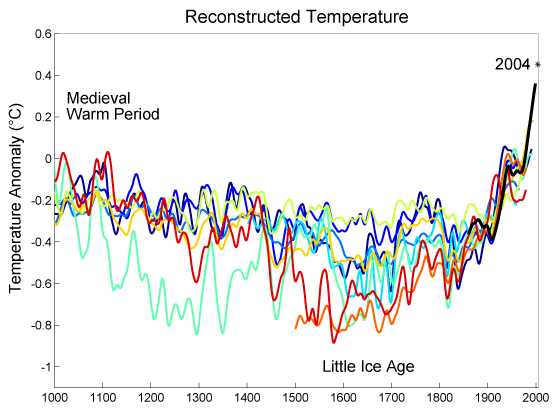
The term “Hockey Stick” was coined by the former head of NOAA’s Geophysical Fluid Dynamics Laboratory, Jerry Mahlman, to describe the pattern common to numerous proxy and model-based estimates of Northern Hemisphere mean temperature changes over the past millennium. This pattern includes a long-term cooling trend from the so-called “Medieval Warm Period” (broadly speaking, the 10th-mid 14th centuries) through the “Little Ice Age” (broadly speaking, the mid 15th-19th centuries), followed by a rapid warming during the 20th century that culminates in anomalous late 20th century warmth (Figure 1). Numerous myths regarding the “hockey stick” can be found on various non-peer reviewed websites and other non-scientific venues.
~ ~ ~ ~ ~ ~ ~
Dec 4, 2004 ... A number of spurious criticisms regarding the Mann et al (1998) proxy-based temperature reconstruction have been made by two individuals McIntyre and McKitrick ( McIntyre works in the mining industry, while McKitrick is an economist). These criticisms are contained in two manuscripts (McIntyre and McKitrick 2003 and 2004–the latter manuscript was rejected by Nature; both are collectively henceforth referred to as “MM”).
MM claim that the main features of the Mann et al (1998–henceforth MBH98) reconstruction, including the “hockey stick” shape of the reconstruction, are artifacts of a) the centering convention used by MBH98 in their Principal Components Analysis (PCA) of the North American International Tree Ring Data Bank (‘ITRDB’) data, b) the use of 4 infilled missing annual values (AD 1400-1403) in one tree-ring series (the ‘St. Anne’ Northern Treeline series), and c) the infilling of missing values in some proxy data between 1972 and 1980. Each of these claims are demonstrated to be false below.
~ ~ ~ ~ ~ ~ ~
Dec 4, 2004 ...
Numerous myths regarding the so-called "hockey stick" reconstruction of past temperatures, can be found on various non-peer reviewed websites, internet newsgroups and other non-scientific venues. The most widespread of these myths are debunked below:
MYTH #0: Evidence for modern human influence on climate rests entirely upon the "Hockey Stick" Reconstruction of Northern Hemisphere mean temperatures indicating anomalous late 20th century warmth.
{...}
MYTH #1: The "Hockey Stick" Reconstruction is based solely on two publications by climate scientist Michael Mann and colleagues (Mann et al, 1998;1999).
{...}
MYTH #2: Regional proxy evidence of warm or anomalous (wet or dry) conditions in past centuries contradicts the conclusion that late 20th century hemispheric mean warmth is anomalous in a long-term (multi-century to millennial) context.
{...}
MYTH #3: The "Hockey Stick" studies claim that the 20th century on the whole is the warmest period of the past 1000 years.
{...}
MYTH #4: Errors in the "Hockey Stick" undermine the conclusion that late 20th century hemispheric warmth is anomalous.
{...}
~ ~ ~ 2005 ~ ~ ~
Jan 6, 2005 ... McIntyre and McKitrick (MM), in one of their many false claims regarding the Mann et al (MBH98) temperature reconstruction, assert that the “Hockey Stick” shape of the reconstruction is an artifact of the “non-centered” Principal Components Analysis (PCA) convention used by MBH98 in representing the North American International Tree Ring Data Bank (ITRDB) data series. We already demonstrated the falsehood of this assertion here by showing (a) that the hockey stick pattern emerges using either the MM (centered) or MBH98 (non-centered) PCA conventions, but was censored by MM through an inappropriate application of selection rules for determining the number of Principal Component (PC) to retain, (b) that use of the correct number of PC series (5) to be kept with the MM (centered) convention retains the characteristic “Hockey Stick” pattern as an important predictor, and yields essentially the same temperature reconstruction as MBH98, and finally (c) the MBH98 reconstruction is recovered even if PCA is not used at all to represent the North American ITRDB Data (i.e., each individual tree-ring series is used as a predictor with equal weight in the analysis).
The claim by MM that the hockey stick pattern arises as an artifact of the PCA centering convention used by MBH98 is seen to be false on multiple levels.
Here, however, we choose to focus on some curious additional related assertions made by MM holding that (1) use of non-centered PCA (as by MBH98) is somehow not statistically valid, and (2) that “Hockey Stick” patterns arise naturally from application of non-centered PCA to purely random “red noise”. Both claims, which are of course false, were made in a comment on MBH98 by MM that was rejected by Nature , and subsequently parroted by astronomer Richard Muller in a non peer-reviewed setting–see e.g. this nice discussion by science journalist David Appell of Muller’s uncritical repetition of these false claims. These claims were discredited in the response provided by Mann and coworkers to the Nature editor and reviewers, which presumably formed the primary basis for the rejection of the MM comment.
~ ~ ~ ~ ~ ~ ~
Jan 10, 2005 ... by Michael Mann, Stefan Rahmstorf, Gavin Schmidt, Eric Steig, and William Connolley
Senator James Inhofe (R) of Oklahoma recently provided us with an update of his views on the issue of climate change in a speech given on the opening senate session, January 4, 2005. His speech opened with the statement:
As I said on the Senate floor on July 28, 2003, “much of the debate over global warming is predicated on fear, rather than science.” I called the threat of catastrophic global warming the “greatest hoax ever perpetrated on the American people,” a statement that, to put it mildly, was not viewed kindly by environmental extremists and their elitist organizations.
Cutting through much of his polemic, Inhofe’s speech contains three lines of scientific argument which, according to him, provide “compelling new scientific evidence” that anthropogenic global warming is not threatening. We here submit his statements to scrutiny.
(1) The Paleoclimate Record
Inhofe relies upon novelist Michael Crichton (see here and here) to support his contention...
(2) Global Sea level Rise
(3) Recent Arctic warming
~ ~ ~ ~ ~ ~ ~
Jan 27, 2005 ... by Michael Mann and Gavin Schmidt
In a previous post, we discussed a number of examples where the “Peer Review” process has failed, and poor papers have been published in the ostensibly peer-reviewed literature. In this context, we revisit our previous discussions of the flawed work of McIntyre and McKitrick (henceforth “MM”). MM published a paper, in the controversial journal Energy and Environment, claiming to “correct” the proxy-based reconstruction of Northern Hemisphere temperatures published by Mann et al (1998–henceforth “MBH98″).
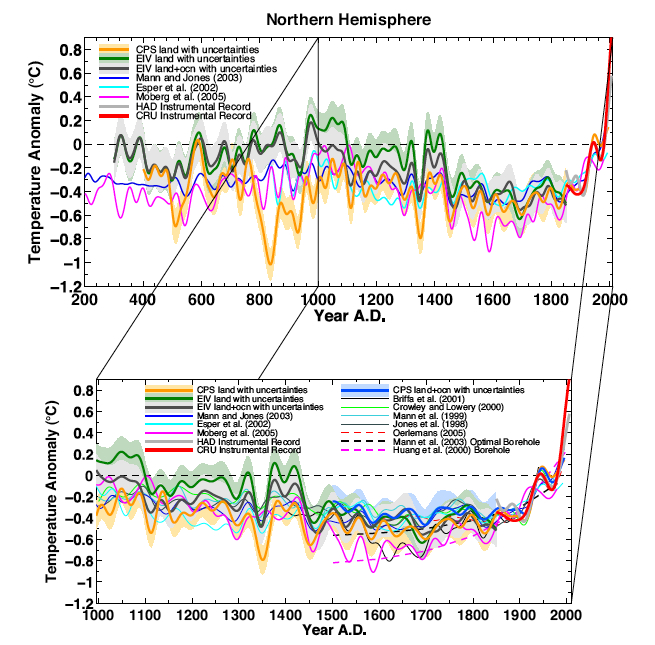
Following the all-too-familiar pattern, this deeply flawed paper was heavily promoted by special interests as somehow challenging the scientific consensus that humans are altering the climate (an excellent account is provided by science journalist Dan Vergano of USA Today here). As detailed already on the pages of RealClimate, this so-called ‘correction’ was nothing more than a botched application of the MBH98 procedure, where the authors (MM) removed 80% of the proxy data actually used by MBH98 during the 15th century period (failing in the process to produce a reconstruction that passes standard “verification” procedures–an error that is oddly similar to that noted by Benestad (2004) with regard to another recent McKitrick paper). Indeed, the bizarre resulting claim by MM of anomalous 15th century warmth (which falls within the heart of the “Little Ice Age”) is at odds with not only the MBH98 reconstruction, but, in fact the roughly dozen other estimates now published that agree with MBH98 within estimated uncertainties.
All of their original claims have now been fully discredited (see e.g. this previous post as well as this discussion of a paper ‘in press’ in the Journal of Climate by Rutherford et al). MM however, continue to promote false and specious claims.
~ ~ ~ ~ ~ ~ ~
Jan 27, 2005 ... So let’s assume for argument’s sake that Mann, Bradley and Hughes made some terrible mistake in their statistical analysis, so we need to discard their results altogether. This wouldn’t change our picture of the last millennium (or anything else) very much: independent groups, with different analysis methods, have arrived at similar results for the last millennium. The details differ (mostly within the uncertainty bounds given by Mann et al, so the difference is not significant), but all published reconstructions share the same basic features: they show relatively warm medieval times, a cooling by a few tenths of a degree Celsius after that, and a rapid warming since the 19th Century. Even without Mann et al, we’d still be stuck with a “hockey stick” type of curve – quite boring.
~ ~ ~ ~ ~ ~ ~
Feb 14, 2005 ... Readers of the Feb. 14th, 2005 Wall Street Journal may have gotten the impression that RealClimate is in some way affiliated with an environmental organisation. We wish to stress that although our domain is being hosted by Environmental Media Services, and our initial press release was organised for us by Fenton Communications, neither organization was in any way involved in the initial planning for RealClimate, and have never had any editorial or other control over content. Neither Fenton nor EMS has ever paid any contributor to RealClimate.org any money for any purpose at any time. Neither do they pay us expenses, buy our lunch or contract us to do research. All of these facts have always been made clear to everyone who asked (see for instance: http://www.sciencemag.org/content/vol306/issue5705/netwatch.shtml).
~ ~ ~ ~ ~ ~ ~
Feb 15, 2005 ... by William Connolley and Eric Steig
The 10th Feb edition of Nature has a nice paper “Highly variable Northern Hemisphere temperatures reconstructed from low- and high-resolution proxy data” by Anders Moberg, DM. Sonechkin, K Holmgren, NM Datsenko, & W Karlin (doi:10.1038/nature03265). This paper takes a novel approach to the problem of reconstructing past temperatures from paleoclimate proxy data. A key result is a reconstruction showing more century-scale variability in mean Northern Hemisphere temperatures than is shown in previous reconstructions.
This result will undoubtedly lead to much discussion and further debate over the validity of previous work. The result, though, does not fundamentally change one of the most discussed aspects of that previous work: temperatures since 1990 still appear to be the warmest in the last 2000 years.
The novel thing about this paper is the use of wavelets (a statistical tool common in image-processing software) to separate the low and high-frequency components of the data.
http://www.realclimate.org/index.php/archives/2005/02/moberg-et-al-highly-variable-northern-hemisphere-temperatures/
~ ~ ~ ~ ~ ~ ~
Feb 18, 2005 ... by Gavin Schmidt and Caspar Amman
Due to popular demand, we have put together a ‘dummies guide’ which tries to describe what the actual issues are in the latest controversy, in language even our parents might understand. A pdf version is also available. More technical descriptions of the issues can be seen here and here.
This guide is in two parts, the first deals with the background to the technical issues raised by McIntyre and McKitrick (2005) (MM05), while the second part discusses the application of this to the original Mann, Bradley and Hughes (1998) (MBH98) reconstruction. The wider climate science context is discussed here, and the relationship to other recent reconstructions (the ‘Hockey Team’) can be seen here.
NB. All the data that were used in MBH98 are freely available for download at ftp://holocene.evsc.virginia.edu/pub/sdr/temp/nature/MANNETAL98/ (and also as supplementary data at Nature) along with a thorough description of the algorithm.
~ ~ ~ ~ ~ ~ ~
Feb 25, 2005 ... Of possible interest to our readers, there was an interview yesterday on the BBC (“Today Programme”) regarding the supposed controversy about the “Hockey Stick”: A climate scientist Professor Michael Mann suggests global warming is caused by mankind (mp3 file). Also available on the BBC website is the real audio file of the interview.
~ ~ ~ ~ ~ ~ ~
Jul 18, 2005 ... by Gavin Schmidt and Stefan Rahmstorf
Many readers will be aware that three scientists (two of which are contributors to this site, Michael Mann and Ray Bradley) have received letters from Representative Joe Barton (Texas), Chairman of the House Energy and Commerce Committee specifically requesting information about their work on the ‘hockey stick’ papers (Mann et al (1998) and Mann et al (1999)) as well as an enormous amount of irrelevant material not connected to these studies.
Many in the scientific community would welcome any genuine interest in climate change from the committee, but the tone and content of these letters have alarmed many scientists and their professional organisations. In the words of Alan Leshner, CEO of the American Association for the Advancement of Science, the Barton letters “give the impression of a search for some basis on which to discredit these particular scientists and findings, rather than a search for understanding.” Other organisations and individual scientists have also expressed strong concerns:
The individual responses have now been delivered (and you can read them here):
These responses emphasise two main points that we have explained in great detail in earlier postings on this site:
~ ~ ~ ~ ~ ~ ~
File Format: PDF/Adobe Acrobat
Aug 31, 2005 ... The untold story of how a front-page article and powerful U.S. politicians morphed former mining executive Stephen McIntyre into a scientific superstar.
His attack on one climate - change study, known as the “hockey stick”— a study
often cited to make the case for global warming— plucked McIntyre from obscurity and got him featured on the front page of the February 14, 2005, Wall Street Journal. The page-one story caught the attention of Rep. Joe Barton (R-TX), chair of the House Committee on Energy and Commerce. By late June, Barton was creating his own headlines by demanding that prominent researchers turn over the raw data from the hockey-stick analysis.
~ ~ ~ ~ ~ ~ ~
Oct 24, 2005 ... Two more teams in the seemingly endless jousting over the ‘hockey-stick’ have just made their entry onto the field. In the first two (of four) comments on the original McIntyre and McKitrick (2005) (MM05) paper in GRL, von Storch and Zorita, and Huybers have presented two distinct critiques of the work of M&M.
The two comments focus on the ‘PC normalisation’ issue raised in MM05 which we discussed previously. Specifically, von Storch and Zorita show that in a GCM model emulation of the Mann, Bradley and Hughes (MBH) method, changing the PC normalisation technique makes no difference to the eventual reconstruction (i.e. it is not the normalisation that creates the ‘hockeystick’), consistent with earlier conclusions. Huybers comments that neither of the two suggested normalisations are actually optimal, and proposes a third method which looks like it gives results halfway between MBH and MM05. However, given the von Storch result, this too is unlikely to matter in the final reconstruction.
~ ~ ~ 2006 ~ ~ ~
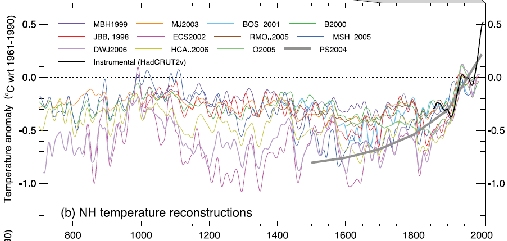
Feb 9, 2006 ... The subject of reconstructions of temperature variations of the past millennium has been discussed many times before on this site (see e.g. here, here, here, and here). Despite the apparent controversy, the basic conclusion–that the global and hemispheric-scale warmth of the past few decades appears anomalous in a very long-term context–has stood up remarkably well in many independent studies (see Figure 1).
This is what Osborn and Briffa have done in their article “The Spatial Extent of 20th Century Warmth in the Context of the Past 1200 Years”, which appears in the Feb 10 issue of the journal Science. The article uses a rigorous statistical methodology to re-examine the question of whether late 20th century warmth is anomalous in the context of the past 1200 years. This is done in a manner that does not require the explicit calibration of the proxy records. In essence, the authors have revisited a question posed earlier in a paper by Willie Soon and Sallie Baliunas (2003: see our previous discussion here), investigating whether or not evidence from past proxy records of temperature support the existence of past intervals of warmth with the widespread global scale of 20th century warming. The Soon and Baliunas (2003) paper was heavily criticized in the scientific literature (e.g. Mann et al, 2003) for failing to distinguish between proxy evidence of temperature and drought or precipitation, and for not accounting for whether temperature anomalies in different regions were contemporaneous or not.
~ ~ ~ ~ ~ ~ ~
Jun 22, 2006 ... The report (NAS synthesis report ) makes due note of this (pg. 119 of the report):
The Mann et al. large-scale surface temperature reconstructions were the first to include explicit statistical error bars, which provide an indication of the confidence that can be placed in the results. In the Mann et al. work, the error bars were relatively small back to about A.D. 1600, but much larger for A.D. 1000–1600. The lower precision during earlier times is caused primarily by the limited availability of annually resolved paleoclimate data: That is, the farther back in time, the harder it is to find evidence that provides reliable annual information. For the period before about A.D. 900, annual data series are very few in number, and the non-annually resolved data used in reconstructions introduce additional uncertainties.
~ ~ ~ ~ ~ ~ ~
Jul 19, 2006 ... It’s not often that blogs come up in congressional hearings, but RealClimate was mentioned yesterday in the Energy and Commerce hearings on the ‘Hockey Stick’ affair. Of course, it was only to accuse us of being part of tight-knit social network of climate scientists, but still, the public recognition is nice.
There is much that could be said about the hearings (and no doubt will be) and many of the participants (Tom Karl, Tom Crowley, Hans von Storch, Gerry North) did a good job in articulating the big picture on climate change independently of the ‘hockey stick’ study as we’ve highlighted before. But it seems to us that there was a missing element in the discussions. That element was the direct implication of the critique that was the principal focus of Wegman’s testimony and that was mentioned periodically throughout the day.
~ ~ ~ 2007 ~ ~ ~
Feb 7, 2007 ... This would not be of much concern if the WSJ wasn’t such an influential paper in the US. However, the extent of its isolation on this issue is evident from the amusing reliance on the error-prone Christopher Monckton. They quote him saying that the sea level rise predictions were much smaller than in IPCC TAR (no they weren’t), that the human contribution to recent changes has been ‘cut by a third’ (no it hasn’t), and that the Summary for Policy Makers (SPM) was written by politicians (no it wasn’t – the clue is in the name).
Even more wrong is the claim that “the upcoming report is also missing any reference to the infamous ‘hockey stick’ “. Not only are the three original “hockey stick” reconstructions from the IPCC (2001) report shown in the (draft) paleoclimate chapter of the new report, but they are now joined by 9 others. Which is why the SPM comes to the even stronger conclusion that recent large-scale warmth is likely to be anomalous in the context of at least the past 1300 years, and not just the past 1000 years.
~ ~ ~ ~ ~ ~ ~
May 29, 2007... Much research effort over the past years has gone into reconstructing the temperature history of the last millennium and beyond. The new IPCC report compiles a dozen reconstructions for the temperature of the Northern Hemisphere (including of course the original “hockey stick” reconstruction, despite opposite claims by the Wall Street Journal). Lack of data does not permit robust reconstructions for the Southern Hemisphere. Without exception, the reconstructions show that Northern Hemisphere temperatures are now higher than at any time during the past 1,000 years (Figure 1), confirming and strengthening the conclusions drawn in the previous IPCC report of 2001. ...
~ ~ ~ 2008 ~ ~ ~
Sep 3, 2008 ... What makes science different from politics?
That’s not the start of a joke, but it is a good jumping off point for a discussion of the latest publication on paleo-reconstructions of the last couple of millennia. As has been relatively widely reported, Mike Mann and colleagues (including Ray Bradley and Malcolm Hughes) have a new paper out in PNAS with an update of their previous work. And this is where the question posed above comes in: the difference is that with time scientists can actually make progress on problems, they don’t just get stuck in an endless back and forth of the same talking points.
We discussed what would be required in an update of these millennial reconstructions a few months back and the main principles remain true now. You need proxies that are a) well-dated, b) have some fidelity to a climate variable of interest, c) have been calibrated to those variable(s), d) that are then composited together somehow, and e) that the composite has been validated against the instrumental record. ...
~ ~ ~ ~ ~ ~ ~
Nov 28, 2008 ... Michael Mann and Gavin Schmidt
Much in the spirit of the Fraser Institute’s damp squib we reported on last year, S. Fred Singer and his merry band of contrarian luminaries (financed by the notorious “Heartland Institute” we’ve commented on previously) served up a similarly dishonest ‘assessment’ of the science of climate change earlier this year in the form of what they call the “NIPCC” report (the “N” presumably standing for ‘not the’ or ‘nonsense’). This seems to be making the rounds again as Singer and Heartland are gearing up for a reprise of last year’s critically…er…appraised “Conference on Climate Change” this March. Recently some have asked us for our opinion of the report and so we’ve decided we ought to finally go ahead and opine. Here goes.
The fact that the very title of the report summary (“Nature, Not Human Activity, Rules the Climate“) itself poses–at best–a false dichotomy is not an auspicious start. The fact that the fonts and layout are identical to the real IPCC report is another indication that this isn’t quite on the level (and reminiscent of the infamous fake PNAS paper that accompanied the first ‘Oregon Petition’).
Reading the table of contents, the report has eight chapters (in addition to an introduction and conclusions chapter). Five of these, quite remarkably, have titles which are simply untrue. The remaining three chapters pose loaded questions which are disingenuous and misleading, if not outright dishonest, with ‘answers’ provided by the authors.
~ ~ ~ 2009 ~ ~ ~
May 2, 2009... Our favorite contrarian, the potty peer Christopher Monckton has been indulging in a little aristocratic artifice again. Not one to be constrained by mere facts or observable reality, he has launched a sally against Andy Revkin for reporting the shocking news that past industry disinformation campaigns were not sincere explorations of the true uncertainties in climate science.
The letter he has written to the NY Times public editor, with its liberal sprinkling of his usual pomposity, has at its heart the following graph:
~ ~ ~ ~ ~ ~ ~
Aug 14, 2009 ... One of the strengths of science is its capacity to resolve controversies by generally accepted procedures and standards. Many scientific questions (especially more technical ones) are not matters of opinion but have a correct answer.
Scientists document their procedures and findings in the peer-reviewed literature in such a way that they can be double-checked and challenged by others. The proper way to challenge results is, of course, also through the peer-reviewed literature, so that the challenge follows the same standards of documentation as did the original finding.
Such a challenge can either be in form of a new, independent paper, or in the form of a comment to a published paper. The latter is the appropriate avenue if the challenge is not based on new data (and is thus a piece of research in its own right), but is a criticism of the methods used in a paper.
~ ~ ~ ~ ~ ~ ~
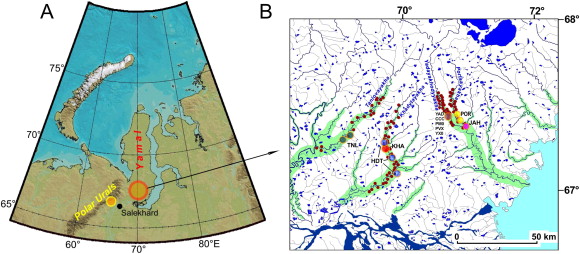
Sep 30, 2009 ... Interesting news this weekend. Apparently everything we’ve done in our entire careers is a “MASSIVE lie” (sic) because all of radiative physics, climate history, the instrumental record, modeling and satellite observations turn out to be based on 12 trees in an obscure part of Siberia. Who knew?
Indeed, according to both the National Review and the Daily Telegraph (and who would not trust these sources?), even Al Gore’s use of the stair lift in An Inconvenient Truth was done to highlight cherry-picked tree rings, instead of what everyone thought was the rise in CO2 concentrations in the last 200 years. ...
~ ~ ~ 2010 ~ ~ ~
Apr 13, 2010 ... The March 20th -26th cover story of The Economist, “Spin, science and climate change,” deftly bypasses the politics surrounding ‘climategate’, to tackle the more important issue: whether any of this has any bearing on climate change science and policy. This is a refreshing bit of journalism that everyone should read.
It is no secret that we have been unimpressed by the quality of reporting of climate science or late. From the insinuation that data were manipulated (for which there remains no evidence, primae facie or otherwise), to the suggestion that “climate skeptics” had somehow been kept from publishing in peer reviewed literature (how, we wonder, does Lindzen keep getting published?), to the blind repetition of false claims of major errors in the IPCC (when only a couple of actual errors – and none of them in the primary (Working Group 1) report – have been found), to the falsehood that climate data have not been readily available (yes, they have), the reporting has been more akin to the populist fearmongering of the McCarthy era than to the celebrated investigative journalism of Watergate.
That’s too bad, and not just because sensationalistic journalism may have done lasting damage to some institutions and individual scientists. More importantly, it has done damage to public understanding, quite the opposite of the rightful role of the free press in a democratic society.
In this context, we were delighted to read the article, and “leader” in the March 20th-26th edition of The Economist. ...
~ ~ ~ ~ ~ ~ ~
Jul 22, 2010 ... Guest commentary by Tamino
Update: Another review of the book has been published by Alistair McIntosh in the Scottish Review of Books (scroll down about 25% through the page to find McIintosh’s review)
If you don’t know much about climate science, or about the details of the controversy over the “hockey stick,” then A. W. Montford’s book The Hockey Stick Illusion: Climategate and the Corruption of Science might persuade you that not only the hockey stick, but all of modern climate science, is a fraud perpetrated by a massive conspiracy of climate scientists and politicians, in order to guarantee an unending supply of research funding and political power. ...
~ ~ ~ 2011 ~ ~ ~
Jan 28, 2011... A few items of interest this week.
Paleoclimate:
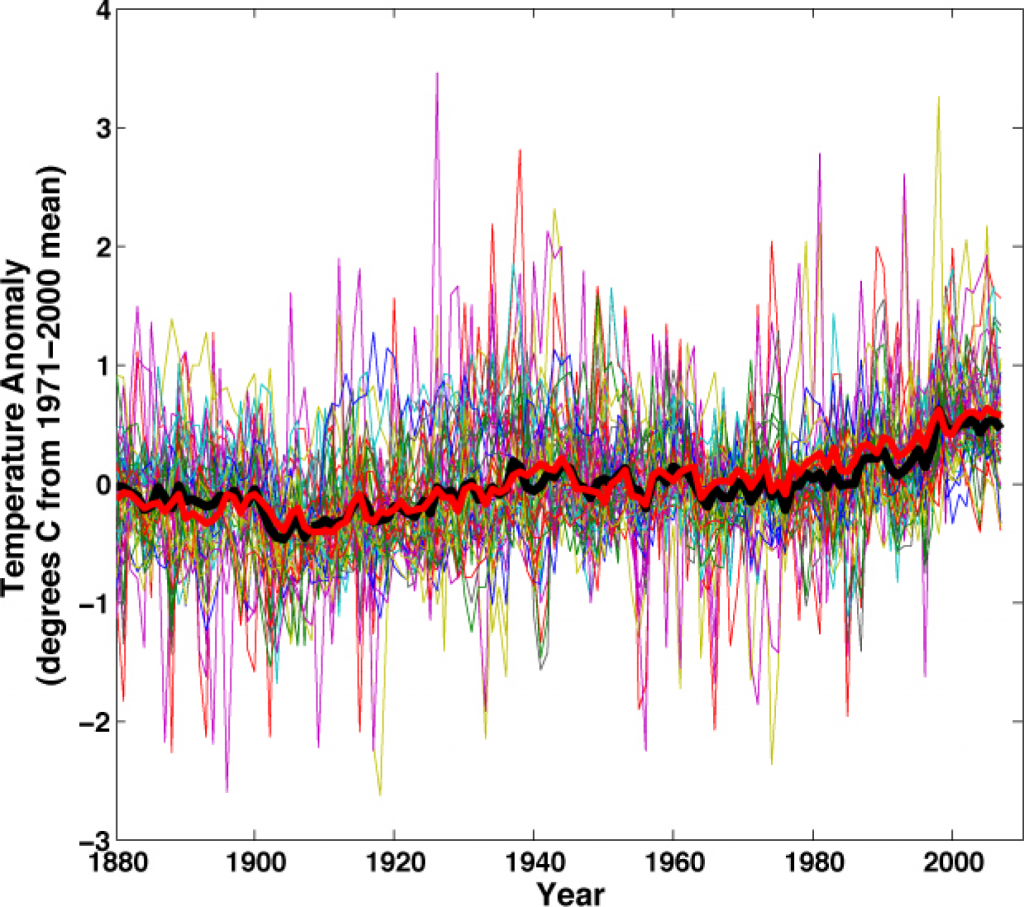
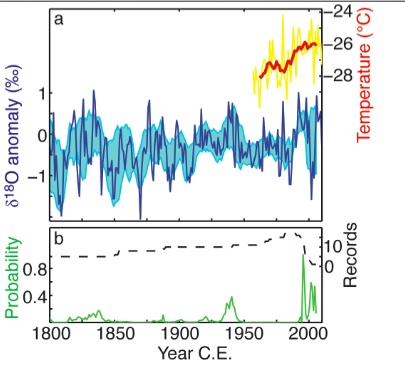
1. A new study by Spielhagen and co-authors in Science reconstructs temperatures of North Atlantic source waters to the Arctic for the past two millennia, adding another very long-handled Hockey Stick to the ever-growing league.
2. From last week, an article in Science Express by Buntgen et al reconstructing European summer temperature for the past 2500 years, finding that recent warming is unprecedented over that time frame, and providing some historical insights into the societal challenges posed by climate instability (listen here for an interview with mike about the study on NPR’s All Things Considered).
3. The team of ice core researchers at WAIS Divide reaches its goal of 3300 meters of ice. [WAIS Divide, central West Antarctica, is a site of significant warming in Antarctica, over at least the last 50 years, a result recently confirmed by the study of O'Donnell et al. (2010); Stay tuned for more on the that soon].
~ ~ ~ 2012 ~ ~ ~
May 22, 2012 ... In the Northern Hemisphere, the late 20th / early 21st century has been the hottest time period in the last 400 years at very high confidence, and likely in the last 1000 – 2000 years (or more). It has been unclear whether this is also true in the Southern Hemisphere. Three studies out this week shed considerable new light on this question. This post provides just brief summaries; we’ll have more to say about these studies in the coming weeks.
First, a study by Gergis et al., in the Journal of Climate [Update: this paper has been put on hold - see comments] uses a proxy network from the Australasian region to reconstruct temperature over the last millennium, and finds what can only be described as an Australian hockey stick...
Second, Orsi et al., writing in Geophysical Research Letters, use borehole temperature measurements from the WAIS Divide site in central West Antarctica, a region where the magnitude of recent temperature trends has been subject of considerable controversy...
Last but not least, a new paper by Zagorodnov et al. in The Cryosphere, uses temperature measurements from two new boreholes on the Antarctic Peninsula to show that the decade of the 1990s (the paper state “1995+/-5 years”) was the warmest of at least the last 70 years.
~ ~ ~ ~ ~ ~ ~
Apr 24, 2012 ... As many will have already heard, our colleague, RC co-founder and friend Michael Mann will receive the Oeschger medal from the European Geosciences Union this week in Vienna. We are delighted to announce this and to congratulate Mike...
Oeschger left rather large shoes to fill, and it is a great honor for Mike Mann to win an award bearing Oeschger’s name. Most everyone will probably assume that the award is for Mike’s well known “hockey stick” work. No doubt this is part of it, but the Oeschger award has never been given simply for the publication of one study, but rather for a career’s-worth of outstanding achievements. ...
~ ~ ~ ~ ~ ~ ~
May 11, 2012 ... Steve McIntyre is free to do any analysis he wants on any data he can find. But when he ladles his work with unjustified and false accusations of misconduct and deception, he demeans both himself and his contributions. The idea that scientists should be bullied into doing analyses McIntyre wants and delivering the results to him prior to publication out of fear of very public attacks on their integrity is ludicrous.
By rights we should be outraged and appalled that (yet again) unfounded claims of scientific misconduct and dishonesty are buzzing around the blogosphere, once again initiated by Steve McIntyre, and unfailingly and uncritically promoted by the usual supporters. However this has become such a common occurrence that we are no longer shocked nor surprised that misinformation based on nothing but prior assumptions gains an easy toehold on the contrarian blogs (especially at times when they are keen to ‘move on’ from more discomforting events).
So instead of outrage, we’ll settle for simply making a few observations that undermine the narrative that McIntyre and company are trying to put out...
~ ~ ~ ~ ~ ~ ~
Jul 8, 2012 ... by Michael E. Mann, Gavin Schmidt, and Eric Steig
It’s been a tough few months for tree-rings, perhaps unfairly. Back in April, we commented on a study [that one of us (Mike) was involved in] that focused on the possibility that there is a threshold on the cooling recorded by tree-ring composites that could limit their ability to capture the short-term cooling signal associated with larger volcanic eruptions. Mostly lost in the discussion, however, was the fact–emphasized in the paper—that the trees appeared to be doing a remarkably good job in capturing the long-term temperature signal—the aspect of greatest relevance in discussions of climate change.
This week there have been two additional studies published raising questions about the interpretation of tree-ring based climate reconstructions...
~ ~ ~ 2013 ~ ~ ~
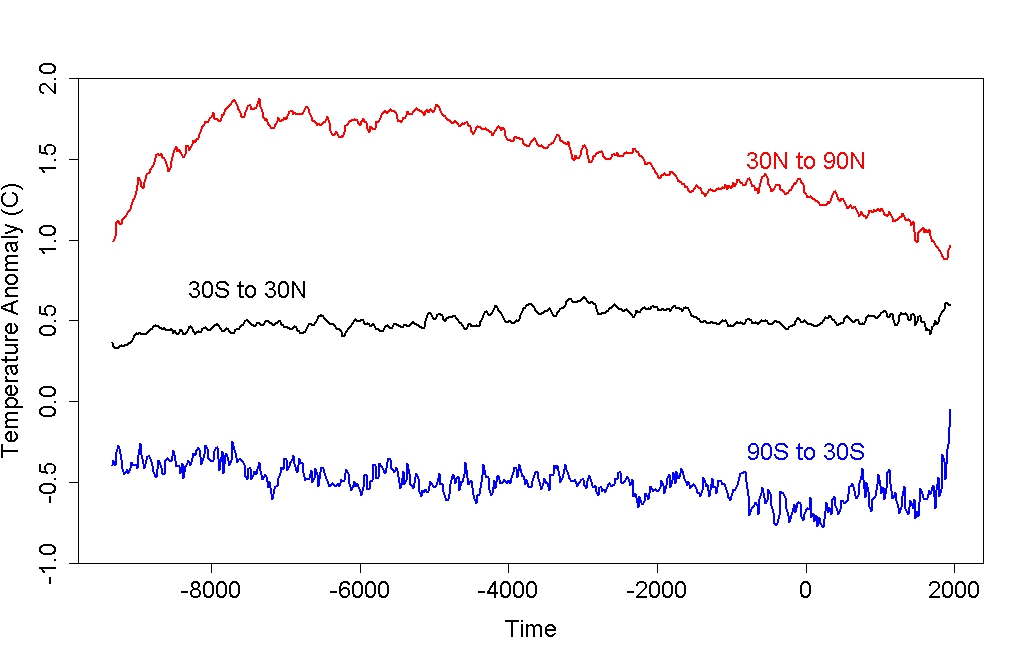
Mar 31, 2013 ... Readers will be aware of the paper by Shaun Marcott and colleagues, that they published a couple weeks ago in the journal Science. That paper sought to extend the global temperature record back over the entire Holocene period, i.e. just over 11 kyr back time, something that had not really been attempted before. The paper got a fair amount of media coverage (see e.g. this article by Justin Gillis in the New York Times). Since then, a number of accusations from the usual suspects have been leveled against the authors and their study, and most of it is characteristically misleading. We are pleased to provide the authors’ response, below. Our view is that the results of the paper will stand the test of time, particularly regarding the small global temperature variations in the Holocene. If anything, early Holocene warmth might be overestimated in this study.
~ ~ ~ ~ ~ ~ ~
Apr 17, 2013 ... Eric Steig
All of these observations match the response, predicted in the late 1970s by glaciologist John Mercer, of the Antarctic to anthropogenic global warming. As such, they are frequently taken as harbingers of greater future sea level rise to come. Are they?
Two papers published this week in Nature Geoscience provide new information that helps to address this question. One of the studies (led by me) says “probably”, while another (Abram et al.) gives a more definitive “yes”.
~ ~ ~ ~ ~ ~ ~
Apr 21, 2013 ... Guest commentary by Darrell Kaufman (N. Arizona U.)
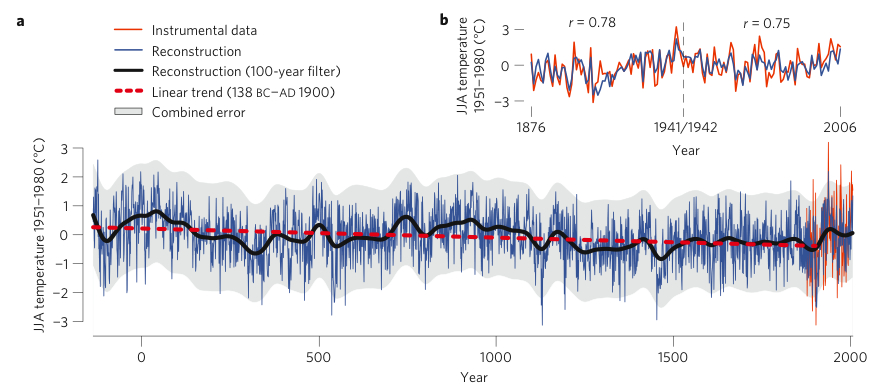
In a major step forward in proxy data synthesis, the PAst Global Changes (PAGES) 2k Consortium has just published a suite of continental scale reconstructions of temperature for the past two millennia in Nature Geoscience. More information about the study and its implications are available at the FAQ on the PAGES website and the datasets themselves are available at NOAA Paleoclimate.
The main conclusion of the study is that the most coherent feature in nearly all of the regional temperature reconstructions is a long-term cooling trend, which ended late in the 19th century, and which was followed by a warming trend in the 20th C.
~ ~ ~ ~ ~ ~ ~
Apr 26, 2013 ... There has been an unusual surge of interest in the climate sensitivity based on the last decade’s worth of temperature measurements, and a lengthy story in the Economist tries to argue that the climate sensitivity may be lower than previously estimated. I think its conclusion is somewhat misguided because it missed some important pieces of information (also see skepticalscience’s take on this story here).
~ ~ ~ ~ ~ ~ ~
Jun 3, 2013 ... Guest commentary from Tim Osborn, Tom Melvin and Keith Briffa, Climatic Research Unit, UEA
...A response to the critics
The publication of our paper provides a timely opportunity to revisit and respond to a series of unfounded criticisms that have been levelled at our work in recent years, mostly originating from Steve McIntyre at the ClimateAudit blog, though they have been widely repeated and embellished by other commentators.
It is of course usual for results to be improved and superseded as science progresses. Our new Yamalia ring-width chronology differs from the Yamal chronology published by Briffa (2000) – see Figure 2a for a comparison...
~ ~ ~ ~ ~ ~ ~
Jul 8, 2013 ... A couple of weeks ago, there was a small conference on Climate Science communication run by the AGU. Both Mike and I attended, but it was very notable that it wasn’t just scientists attending – there were also entertainers, psychologists, film-makers and historians. There were a lot of quite diverse perspectives and many discussions about the what’s, why’s and how’s of climate science communication.
~ ~ ~ ~ ~ ~ ~ ~ ~ ~ ~ ~ ~ ~ ~ ~ ~ ~ ~ ~ ~ ~ ~ ~ ~ ~ ~ ~
http://www.realclimate.org/wiki/index.php?title=The_hockey_stick_is_broken